Navigate Every Stage
Direction
When It
Matters
Most
Mind
Compass
#RecommendedCare
#PersonalisingMentalHealthJourneys
#ServiceRecommendations
Duration : 4 Months
|
Role: Lead Product Designer for the project
|
Platform: App & Web
|
H2 (Q3+Q4) : Major strategic initiative
Project Overview
“Mind Compass” Your Compass for Mental Health, Every Step of the Way.
Designed an AI-powered service recommendation system for a global mental health platform serving 4M+ users across 100+ countries, addressing low service conversion (<10%) and ~20% early drop-offs. Enabled personalized, clinically-backed care pathways to improve user decision-making and engagement.
At Intellect, millions of users complete mental health assessments daily, yet many struggle with a key question: “Where do I begin?”
This initiative was a top strategic priority for the company, focused on simplifying decision-making and guiding users to the right care.
• Designed for 18–25% engagement (CTR)
• Targeted 42–48% completion rate
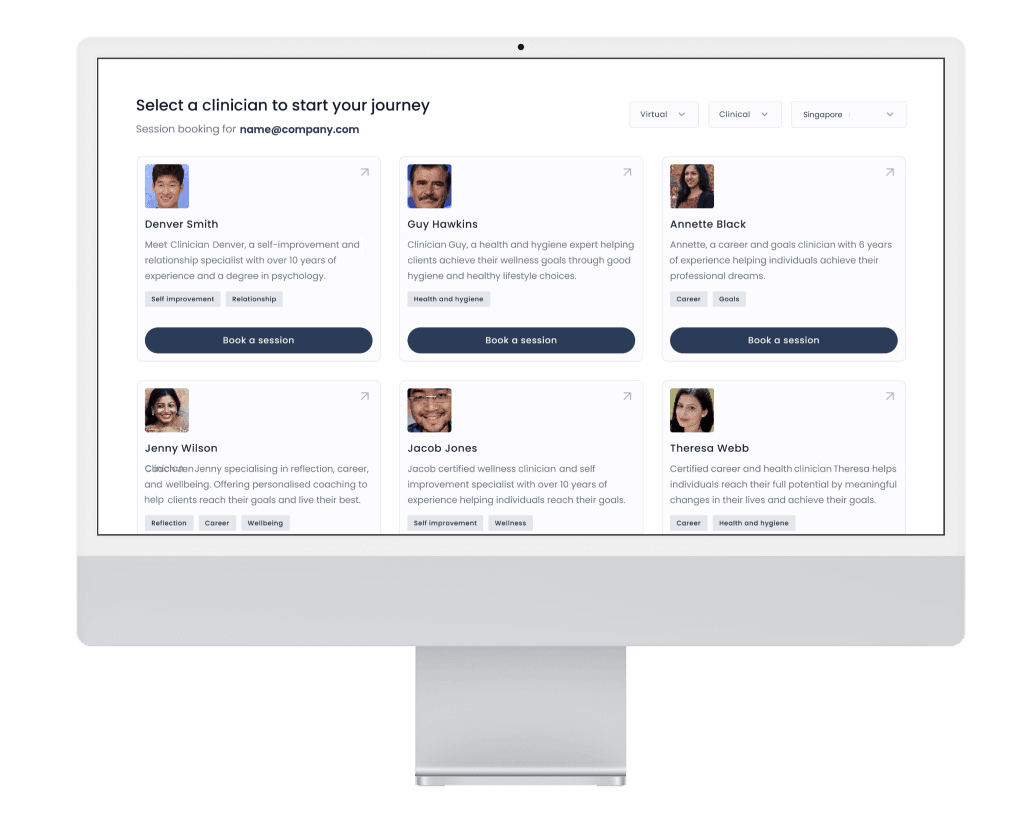
For me, this project wasn’t just professional, it was personal. Having navigated my own mental health journey, I approached the work with empathy and urgency, knowing that clarity and trust can define whether someone takes the first step toward care.
Identifying the gap and understanding the PROBLEM
28%
Engagement drop-off
Only 28% of new users engaged with a service after completing an assessment. Over 60% dropped off entirely.
Choice paralysis
With therapy, coaching, content, and holistic options, users felt overwhelmed and uncertain.
Isolated systems
Assessments existed in isolation, and the Care tab offered no personalization or context.
"The app is overwhelming with content. I don't really know where to start."
— User feedback from user interview
The challenge extended beyond users.
Providers lacked contextual insight, often being matched with clients whose needs fell outside their expertise or therapeutic approach. This created inefficiencies in care delivery and diluted the overall impact of sessions.
Organizations/HR leaders struggled to demonstrate measurable impact, as fragmented user journeys and low engagement made it difficult to correlate care utilization with mental health outcomes or ROI.
For Intellect, this highlighted a deeper opportunity to connect scattered features into personalized care pathways that drive trust and measurable outcomes.
Research & Insights
To build a meaningful recommendation system, I and my project manager led a multi-layered
research process combining data, behavior insights, and stakeholder alignment and cross-functional workshop.
Behavioral insight
the “Golden Window”
Motivation peaks right after self-awareness (Fogg Behavior Model).
For Intellect users, this occurred post-assessment.
A high-intent moment too valuable to lose to a static screen.
Cross-functional workshop
Led a 20+ person workshop across product, clinical, and tech teams.
Identified gaps: disconnected flows, overwhelming choices.
Flagged unclear outcomes and ethical constraints in recommendations.
Quantitative & Qualitative evidence
Analytics showed steep drop-offs after assessments.
Users felt “curious but unsure what to do next.”
Competitors lacked adaptive, multilingual recommendation systems.
Step
Focus
Outcome
1
Self-Discovery
Users complete assessments
PHQ-4
→
WSAS
→
Safety
Creates personal insight
2
Insight Generation
Backend benchmarks interpret scores and analyze patterns to provide meaningful context
Defines risk tier
3
Recommendation Moment
Personalized Next Best Action card appears with tailored
recommendations
Empathetic
guidance
4
Guided Journey
User follows smooth transition to care or self-help resources with continuous support
Drop-offs reduced
Guiding Statement & Hypothesis
Guiding Statement
“
One clear next step, explained with empathy, at the exact moment of readiness.
Hypothesis
If we connect assessments to actionable recommendations through clear, empathetic design, users will feel guided- increasing engagement, trust, and care uptake.
Framing the system
Users learn more about their well-being through assessments.
Personalized summaries highlight key dimensions (stress, resilience, balance).
Service Recommendation surfaces the most relevant care options.
Users act on recommendations, track progress, and explore supportive tools.
Recommendation Moment
Guided Care Journey
Self-Discovery
Insight Generation
Design approach; Connecting Insights to Action
This creates a natural progression that feels intuitive:
User Profile
Understanding the Whole Human;
People are multi-dimensional- shaped by intersecting roles, experiences,
and emotions. Someone navigating anxiety might also be a manager handling team stress, a new parent adjusting to postpartum changes, or a partner working through relationship shifts.
The goal is to design a journey that recognizes this lived complexity- one that sees users not as isolated symptoms or behaviors, but as whole individuals whose mental well-being is influenced by every part of their life.
Wireframes & Iteration in Motion
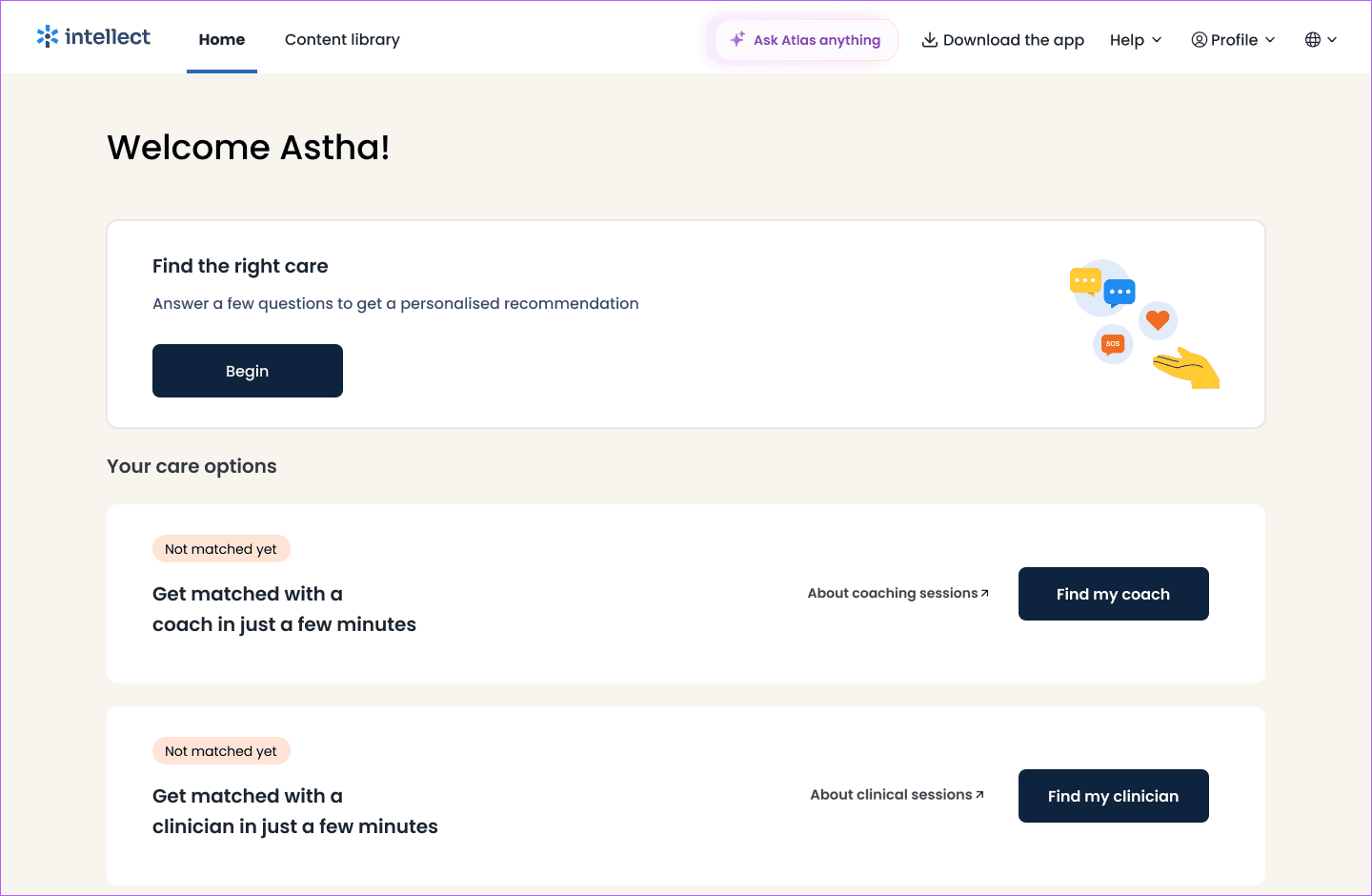
Designing Mind Compass was never “one and done.” It evolved through multiple design cycles, feedback loops, and usability validations, a collaborative journey that transformed early concepts into a cohesive, ethically sound, and technically feasible experience.
The Guiding Statement, hypothesis, research & Insights translated into tangible design decisions:
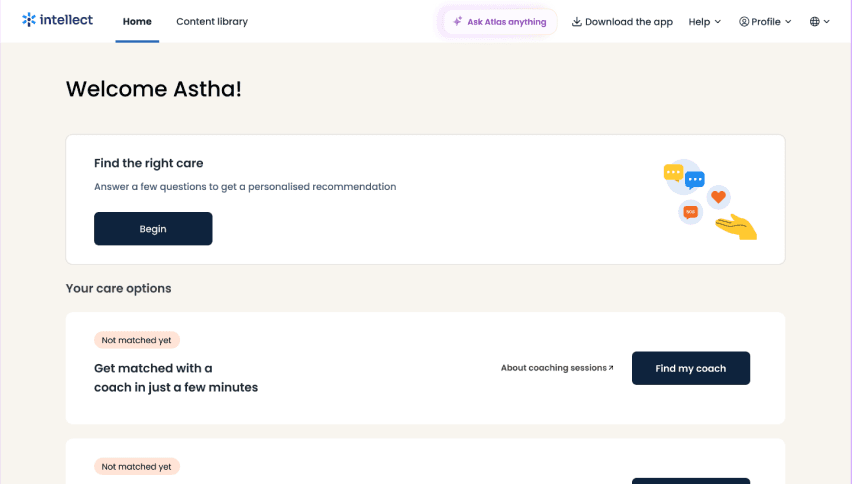
Introduce a Next Best Action (NBA) card on the home screen to create visibility and immediacy.
Offer contextual service education (Eg: Coaching vs Clinical) to reduce decision fatigue.
A unified backend recommendation API ensuring parity across App and Web.
Build layered information architecture that keeps the interface light but explorable.
Design Exploration & Component Evolution
Designing for this feature was never “one and done” since its within live ecosystems;
The process was a series of iterations, reviews and refinements that ultimately shaped the final flow.
NBA Card
1
Start with a
PHQ 4 assessment
A short 4-question check-in.

Start Check In
2

Assessment | 5 min
Start your well-being journey today
Understand where you’re at and get personalised support
Take assessment

3
SOS
Find the right help
Answer a few questions to get a personalised recommendation
Begin
The final NBA card (No. 3) was selected for its clarity, visual warmth, and adaptability, anchored by a centered, high-visibility CTA designed for effortless tap-accuracy and future reusability, making it a scalable component that integrates seamlessly into the existing UI while supporting evolving NBA use cases and triage scenarios on the Home tab.
Primary Recommendation Card
1
1:1 Clinical Session
Professional care to help you manage and heal.
Find a clinician
1:1 Coaching Sessions
Professional coaches to help you get to your goals.
Find a coach
2
Begin coaching
Certified coaches
1:1 Sessions
100% Private
Find a coach
3
Individual coaching
Work with a qualified professional to manage emotions, set goals and navigate life’s challenges.
Find a coach
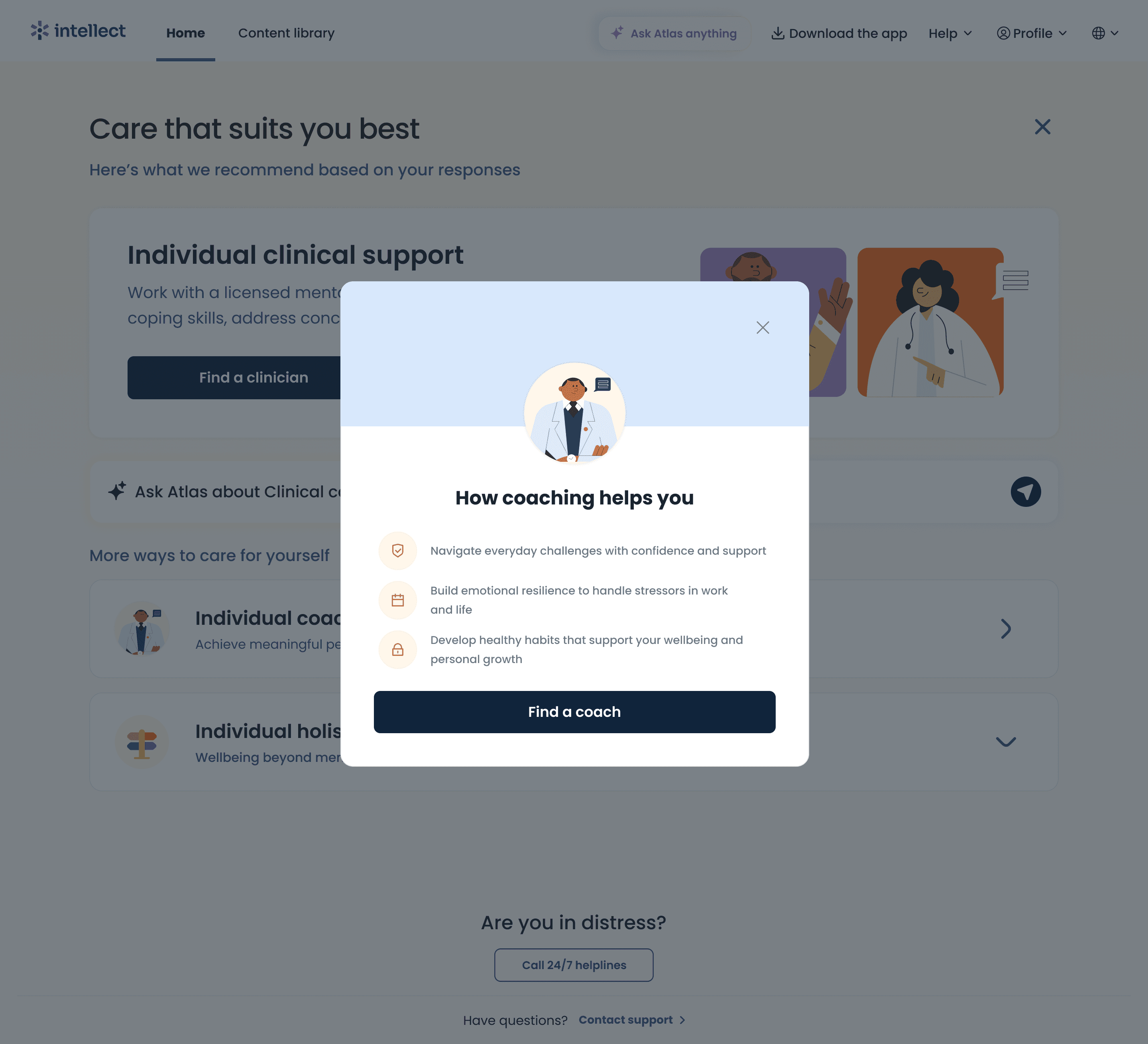
The final primary recommendation card (No. 3) was selected for its balanced information hierarchy, stronger visual presence, and clearer educational value, expanding from earlier compact layouts into a more action-forward, high-visibility component that helps users quickly understand the recommendation and confidently take the next step.
Secondary Recommendation Cards
1
1:1 Clinical care sessions
Connect with licensed therapists who can help you develop coping strategies.
Find a clinician
Financial coaching
Manage money stress with expert guidance
Start now
Nutrition coaching
Build healthy habits that support how you feel
Start now
2
1:1 Coaching sessions
Focused coaching for personal and professional growth
Financial coaching
Manage money stress with expert guidance
Financial coaching
Manage money stress with expert guidance
3
Individual clinical support
Build resilience in safe space
Individual coaching
Achieve meaningful personal growth
Individual holistic coaching
Wellbeing beyond mental health
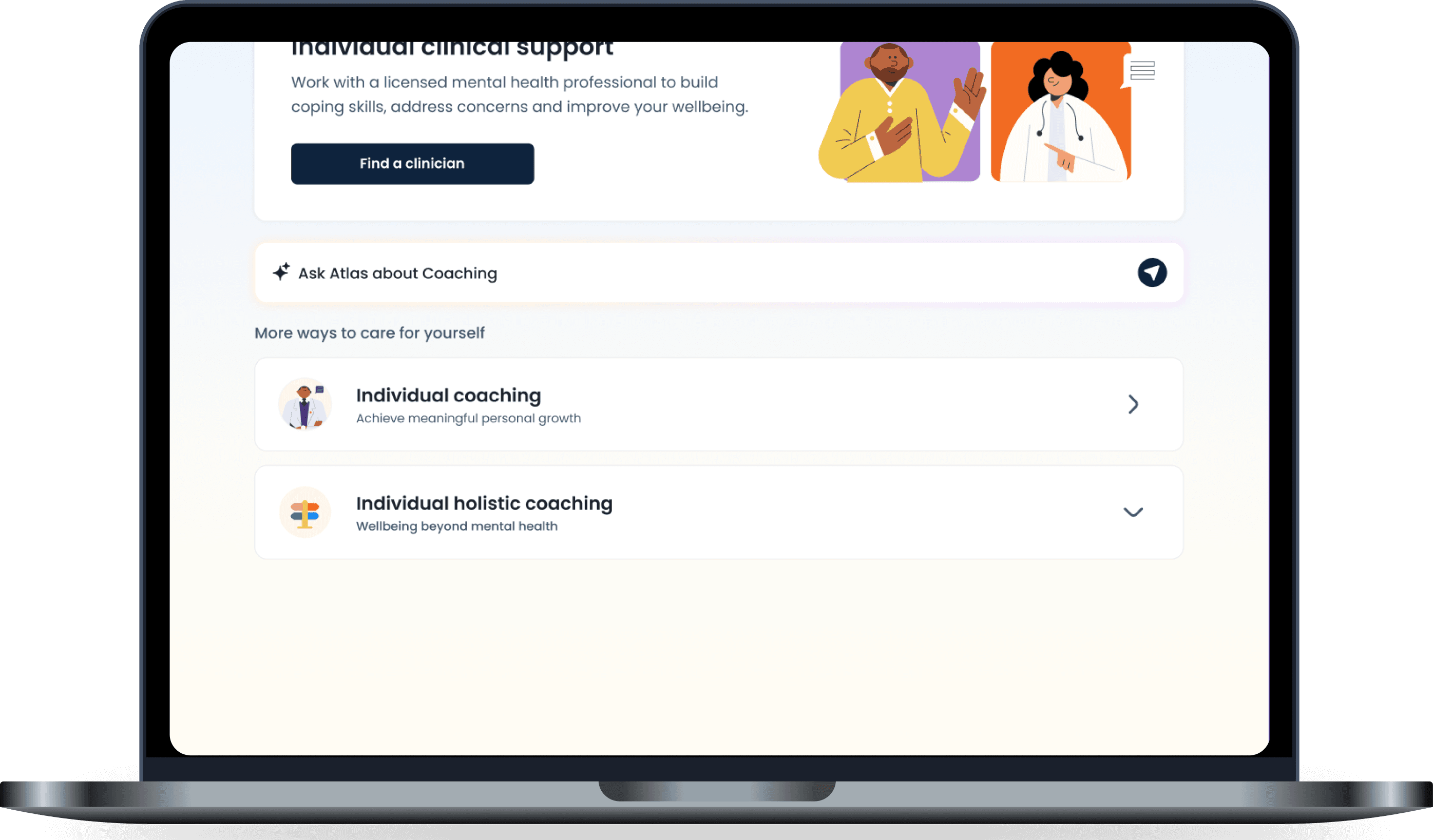
The final secondary recommendation cards (No. 3) were selected for their structured hierarchy, clear service options, and accordion-based educational layer, creating a concise yet informative component that supports multiple use cases, respects the primacy of the main recommendation, and offers users an easy, intuitive way to explore alternative care paths without overwhelming the page.
System Constraints & Trade-offs
Working within live ecosystems required deliberate compromise:
Speed vs Completeness
PHQ-9 → PHQ-4 for shorter flows & higher completion.
Education vs Cognitive Load
Bottom sheets replaced heavy on-card explanations to reduce cognitive load.
Parity vs Platform
Logic remained consistent; UI adapted to different APIs.
Component System &
Multi-Platform Consistency
Designed a scalable component system for both App and Web, adapting layout and interaction patterns per platform while keeping logic identical.
Built reusable modules- recommendation cards, accordions, CTAs, tags; flexible enough for future Mind Compass flows.
App uses more compact, tap-friendly structures; Web adopts wider grids, but the system behaves consistently across both.
Microcopy & UX Content
Kept microcopy consistent across App and Web to maintain clarity and tone.
Wrote content to feel calm, invitational, and non-judgmental, supporting users through sensitive moments.
Used optional educational layers (like accordions) to add depth without overwhelming the page.
Design Thinking & Key Decisions
Role & Responsibilities
Led end-to-end UX design for the Service Recommendation system
Defined user flows, interaction logic, and recommendation experience
Collaborated with product, clinical, and engineering teams
Translated clinical frameworks into intuitive user journeys
Product Decisions
Introduced guided recommendations to reduce decision paralysis
Used clinical triaging (PHQ-4, WSAS, suicide ideation) for accurate personalization
Designed dynamic pathways based on user risk levels
Balanced simplicity with clinical accuracy in a sensitive context
System Design & Personalization
Designed a multi-step triaging system (PHQ-4, WSAS, suicide ideation)
Built a dynamic engine mapping users to coaching, clinical, or helpline support
Created context-aware flows based on user state and service availability
Integrated AI-assisted guidance to support decision-making
Challenges & Trade-offs
Balanced clinical accuracy with a low-friction experience
Reduced drop-offs while maintaining assessment depth
Designed ethically responsible flows for high-risk users
Ensured clarity without overwhelming users in sensitive scenarios
High-Level Journey Map
Through iterative design and cross-functional reviews, I shaped the end-to-end journey
and refined a triage system that moves users smoothly from assessment to recommendation.
Annotated User Flow
Detailed breakdown of assessment journey stages
Stage
Purpose
Key Logic
Outcome
1
NBA Entry
Launch point (Home)
Tap → start PHQ-4
Flow begins
2
PHQ-4
Screen for anxiety/depression
0-5→Coaching
6-8→WSAS
9-12→WSAS+Safety
Path set
3
WSAS
Gauge functional impact
≤10→Coaching
11-20→Clinical
>20→Safety
Refined tier
4
Safety Check
Flag risk intent
Yes→Helpline
No→Clinical
Escalate/Continue
5
Recommendation
Show care card
Backend triggers NBA card
User acts
6
Transition
Keep momentum
Smooth UI + microcopy
Drop-off ↓
Triage Decision Table
Assessment scoring logic and care pathway routing
Logic Overview
This decision matrix routes users through progressive assessments based on risk levels. PHQ-4 scores determine initial pathways, while
WSAS provides functional impact assessment for moderate-to-high risk users. Safety checks ensure appropriate escalation for severe cases.
Assessment
Score
Risk Tier
Next Flow
Recommendation
PHQ-4
0-5
Low
—
Coaching
PHQ-4
6-8
Mod
WSAS
Clinical (if WSAS ≥ 11)
PHQ-4
9-12
High
WSAS
+
Safety
Clinical
/
Helpline
WSAS
≤10
Min
—
Coaching
WSAS
11-20
Mod
—
Clinical
WSAS
>20
Sev
Safety
Clinical
+
Escalation
—
—
—
If service is unavailable
Care Navigator
The MASTER Flow
The polished, production-ready experience
Final End-to-End Mind Compass Flow- PHQ-4 → WSAS → Safety → Recommendation → Pathways
Safety, Escalation & Redirection
Service Unavailability
If a recommended service isn’t available,
Mind Compass redirects users to the
“Care Navigator”, ensuring they still receive
a relevant and supportive path forward.
Ethics & Compliance
AI functions as a contextual companion- “never a caregiver” with “consent and privacy” upheld per regional regulations for all users.
Safety & Monitoring
Suicide “Yes” responses trigger an immediate Slack alert to the clinical team with a callback within 1 hour, alongside weekly monitoring for unmatched users.
What AI Is
Good At
What Humans Still Do Best
Atlas
Intellect
Escalation
AI can flag risks faster than humans, according to early trials
Insights
AI makes data-driven recommendations like best-fit therapists
Paperwork
AI automates administrative tasks like scheduling and note-taking
Ethics
Humans understand
when confidentiality should be breached
Intuition
Humans with lived experiences have a better grasp of context
Relationship
When words fail, the presence of a trusted person can be healing
Projected Outcomes & Impact
Expected impact of these 4 Metric based on behavioral insights and early funnel signals,
focused on engagement, completion, and safety outcomes.
Card CTR
Target Range- 18–25 %
Goal → Increase engagement
Questionnaire Completion
Target Range- 42–48 %
Goal → Higher retention
Drop-off Reduction
Target Range- 10–15 % ↓
Goal → Seamless journey
SOS
Safety Coverage
Target Range- 100 %
Goal → SOP compliance
“ This project strengthened my conviction that true product maturity lies in creating
systems that evolve with people’s needs and guide with care, not control.”
Conclusion & Reflection
Outcome: Delivered a scalable, AI-driven recommendation system that simplifies complex mental health decisions and improves engagement through personalized, evidence-based care pathways.
This initiative was about responsibility, not just usability. It meant balancing clinical sensitivity, ethical AI boundaries, and cross-functional constraints to turn uncertainty into guided clarity.
With V1 in place, the next phase (V2) will deepen personalization, strengthen session matching, and expand educational pathways, building on the system foundation created here. This project taught me how to design for complexity without overwhelming users, and how clarity, trust, and emotional safety must shape every decision in mental health.
Thank you for taking the time to explore.
For any questions, please write in to asthajain14official@gmail.com
Mental Health
Industry
Building What Matters
-Astha Jain